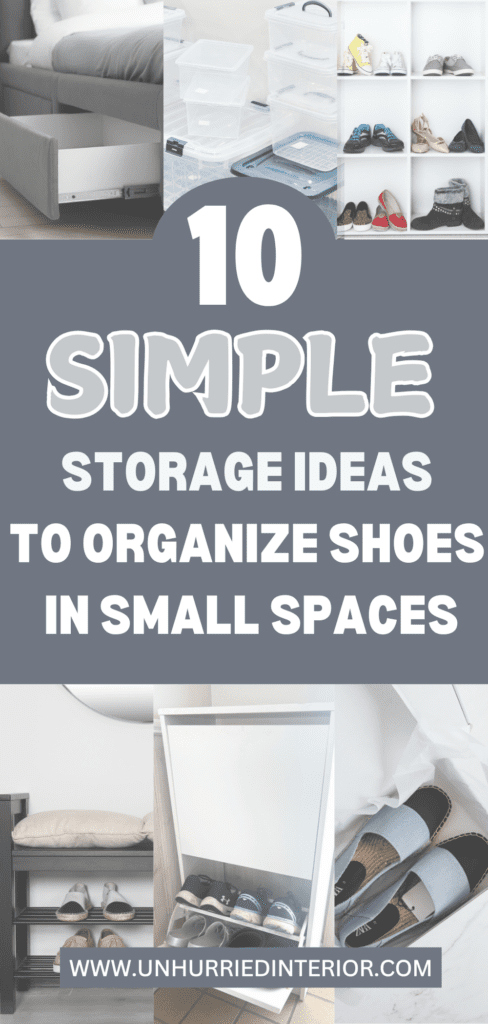
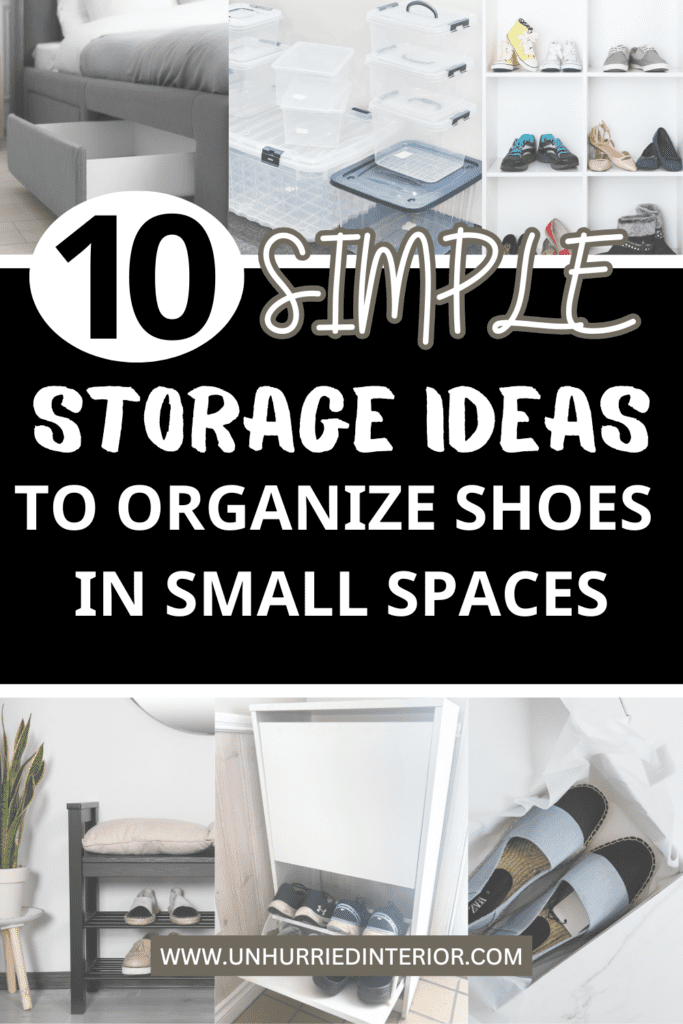
10 Simple Storage Ideas to Organize Shoes in Small Spaces
This post tells you how to organize shoes in small spaces so you can maintain a tidy space!
If you’ve ever tried to figure out how to organize shoes in small spaces, you already know it can feel like an impossible task. A pile of shoes by the front door, high heels tumbling off a shelf, flip flops shoved under the bed — and somehow your current shoe collection still manages to take over every inch of available space you have. In a small home or small apartment, every square foot matters, and shoes are one of the hardest things to keep together because they come in awkward shapes, different sizes, and you need them to be in plain sight and easy access at the same time.
The good news is that organizing your footwear collection in limited space doesn’t require a closet renovation or a trip to a container store. With the right creative shoe storage ideas and a little intention, you can create a well-organized shoe collection that works beautifully — even in the tightest of small spaces.
How to organize shoes in small spaces: The most effective way to organize shoes in small spaces is to first sort your current shoe collection by frequency of use — everyday wear in the most accessible spot, seasonal wear and special occasion shoes stored out of the way. Then use vertical space, under-bed storage, and door storage to maximize every inch of available space without cluttering your floor space. The best shoe storage ideas work with the specific storage solutions your home already allows rather than fighting against the layout.
Why your shoes always end up in a pile — and how to fix it
The first step to a well-organized shoe collection isn’t buying anything — it’s understanding why the current system keeps failing. In most small spaces, shoes pile up near the front door or on the closet floor because there’s no designated home for each pair of shoes. Without a specific storage solution for each type of shoe — work shoes, dress boots, everyday wear, children’s shoes — they all end up in the same chaotic pile.
The initial step before implementing any of the ideas below is a quick sort. Pull every pair of shoes out and divide them into three groups: shoes you wear for everyday wear, shoes for seasonal wear, and shoes for special occasions. This one step tells you exactly how much storage space you need and what type of storage makes the most sense for your small apartment or small home.
Shoes you reach for daily need quick access. Work shoes and dress shoes that you wear a few times a week can live on open shelving or a small shoe rack. Special occasion shoes, winter boots, and dress boots that only come out a few times a year can go into clear shoe boxes, under-bed storage, or the top shelf of your small closet — out of the way but still protected.
1. Use vertical space — your most underused storage space
In small spaces, vertical space is almost always underused. Most people store shoes at floor level and leave an entire wall of available space completely empty above. Installing a door shoe rack on the back of your closet door or bedroom door is one of the fastest, most affordable ways to immediately multiply your storage space without using any floor space at all.
Door organizers with clear pockets are especially useful because they let you see every pair of shoes at a glance — no digging, no guessing. A door shoe rack with clear pockets works beautifully for everyday wear like flats, flip flops, and work shoes that you reach for frequently and need quick access to.
For a more permanent solution, built-in shelves or vertical shoe racks on the wall give you open shelving that keeps your footwear collection visible, accessible, and off the floor. Adjustable shelving is the best option here because you can modify the shelf space to accommodate different heights — tall boots need more room than flip flops, and having that flexibility means no wasted dead space between shelves.
These over-door clear pocket organizers are what I keep recommending for small closets — they hold up to 24 pairs of shoes, install in seconds with no tools, and the clear pockets mean you can see every pair without pulling anything out. One of the best shoe storage ideas for renters who can’t put holes in walls.
2. Under-bed storage for seasonal wear and special occasion shoes
Under-bed storage is one of the best ways to store shoes you don’t need for everyday wear without sacrificing any of your usable living space. Most beds have between 7 and 13 inches of clearance underneath — enough to store several pairs of shoes flat in shallow bins or rolling drawers. This is the perfect spot for seasonal wear like winter boots and dress boots, special occasion shoes you only pull out a few times a year, and children’s shoes in sizes they haven’t grown into yet.
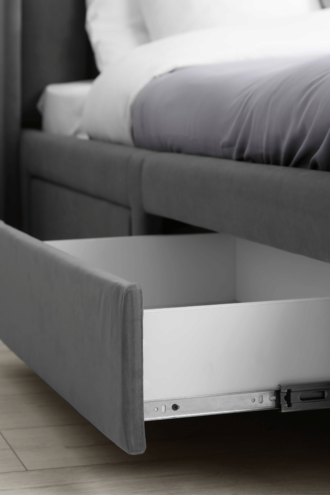
The most effective under-bed storage solutions for shoes are shallow rolling drawers with dividers, which keep pairs of shoes separated and allow you to pull the whole drawer out without getting on your hands and knees. Clear shoe boxes that stack flat under the bed work equally well and have the added benefit of protecting your shoes from dust.
I’ve seen this under-bed rolling shoe drawer change how people store seasonal wear completely — it holds up to 12 pairs of shoes, rolls out smoothly on wheels, and the clear top means you can see every pair without pulling it all the way out. The thing I hear most from people who try it is that they had no idea how much dead space was under their bed all along.
A few things to keep in mind for under-bed shoe storage: always store shoes in a dry place away from moisture, use shoe trees in leather dress shoes and dress boots to help them hold their shape during longer storage periods, and give wet weather boots time to dry completely before putting them away to prevent damage and odor.
3. A shoe storage bench for your entryway or closet
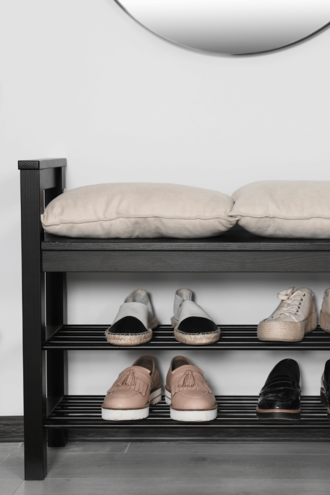
If you have a small entryway or a small closet with enough floor space for one piece of furniture, a shoe storage bench is one of the most practical shoe storage solutions available. It does two things at once — provides a seat for putting shoes on and taking them off, and offers hidden storage underneath for your most-used pairs of shoes.
A shoe storage bench near the front door solves one of the most common small space problems: shoes that get kicked off at the door and never make it back to the closet. When the storage is right there at the door, the shoes actually get put away because the effort required is minimal. This is the calm home principle applied to organization — make the right thing the easy thing.
The best shoe storage bench options for small spaces have compartments or cubbies that keep pairs of shoes separated rather than just a hollow box where everything slides around. Some have a closed cabinet style with doors for a cleaner, more minimalist storage look, while others have open cubbies for quick access to everyday wear.
This shoe storage bench is my top pick and it comes in many colors. Plus the seat is sturdy enough to actually sit on, the cubbies hold four to six pairs of shoes depending on the size, and the clean look works in an entryway without making the space feel cluttered. Worth every penny for small entryway organization.
4. Open shelving for your most-used pairs
Open shelving is one of the best shoe storage ideas for shoes you reach for constantly — everyday wear, work shoes, and the pairs you cycle through most during the week. When shoes are in plain sight on open shelving, you can grab exactly what you need without opening anything, moving anything, or disturbing the rest of your organized system.
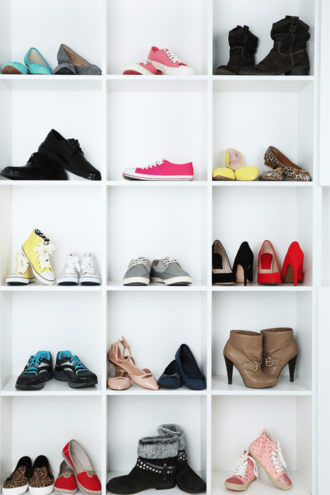
The key to open shelving that looks calm rather than chaotic is editing ruthlessly. Only the shoes you wear most often earn a spot on open shelving. Everything else — special occasion shoes, seasonal wear, dress boots — goes into closed storage or under-bed storage. When open shelves hold too many pairs of shoes, the neater approach is immediately undermined and the whole system starts to feel like a pile of shoes on a shelf rather than an organized display.
For a visually satisfying look on open shelving, store shoes in pairs facing the same direction, group similar types together — all work shoes together, all casual shoes together — and consider color coordination within each group. It takes an extra thirty seconds when you put shoes away and makes the whole shelf look like it was styled intentionally.
A tension rod installed low in a closet can act as a simple hanging rod for heels — slip the heel over the rod and suddenly you have a vertical shoe rack that uses zero shelf space and keeps high heels visible and accessible without taking up any floor space.
5. Clear shoe boxes for a clean look and easy visibility
Clear shoe boxes are one of the most satisfying shoe storage solutions for anyone who wants a clean look with easy visibility across their entire footwear collection. Unlike opaque boxes, transparent storage boxes let you see every pair of shoes at a glance without opening anything — which means you spend less time searching and more time actually using your shoes.
Stackable clear shoe boxes make excellent use of vertical space in a small closet and keep your shoes protected from dust and damage during longer storage periods. They work especially well for special occasion shoes, dress boots, and high heels that you want to protect but still be able to find quickly.
These stackable clear shoe boxes are highly recommended for seasonal wear — they’re sturdy enough to actually stack without collapsing, the lids click securely so nothing falls out when you move them, and the front-opening design means you can access shoes from a stack without dismantling the whole thing. Labeling the front of each box with a small sticky note takes ten seconds and makes the whole system amazing.
For a more minimalist storage approach, these uniform white shoe boxes give a cleaner look on open shelving while still protecting your shoes — add a few details on the front and you get a closet that feels more like a daily shopping spree every time you pick out a pair of shoes.
6. A shoe storage cabinet for a minimalist, closed storage look
A shoe storage cabinet is the best option when you want all the organizational benefits of a dedicated shoe storage system but prefer a closed cabinet look that hides your footwear collection completely. Unlike open shelving or small shoe racks, a shoe cabinet keeps everything behind doors — which immediately makes a small entryway, living room, or bedroom feel more calm and uncluttered.
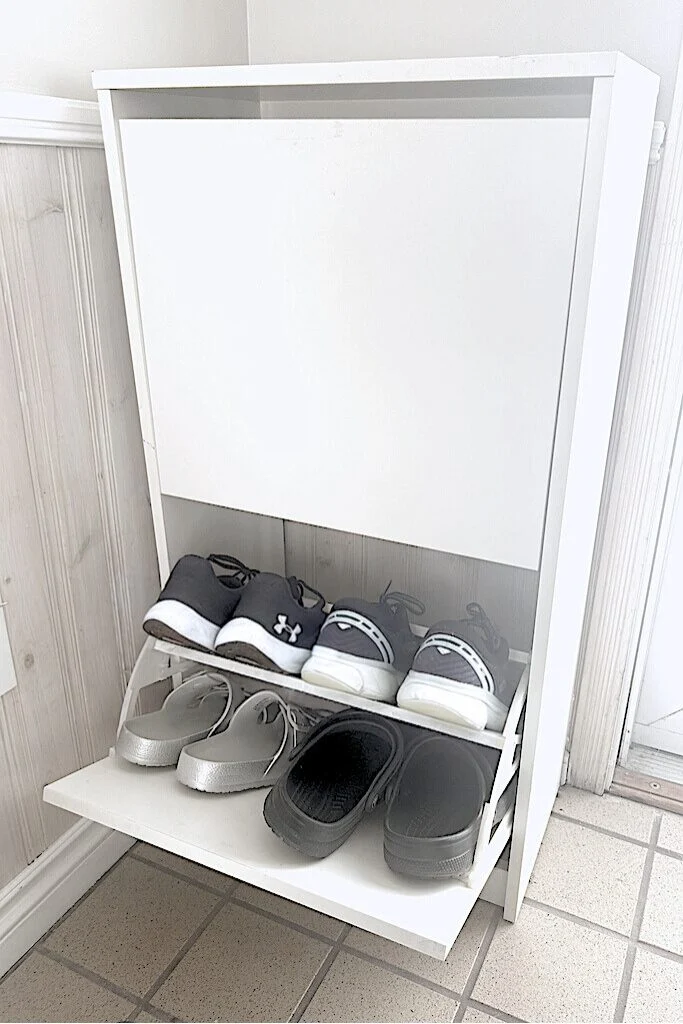
Shoe storage cabinets work particularly well in narrow spaces because they tend to be more compact than other furniture pieces and can fit into tight areas like a corner of a closet, a narrow hallway, or beside a coat closet. Many have a modern look with clean lines that works in a slow living or minimalist home aesthetic — they look like a piece of furniture rather than a storage solution, which makes them easy to place in living spaces that guests will see.
The best shoe storage cabinet options have multiple compartments or adjustable shelves inside so you can customize the storage space to your current shoe collection — taller compartments for boots and high heels, shorter ones for flats and work shoes.
This shoe storage cabinet is my other favorite way to organize shoes in small spaces — the flip-down door design means it takes up almost no clearance space when you open it, it holds up to 32 pairs of shoes in a footprint that’s about the size of a nightstand, and the clean look is beautiful in an entryway. The thing I notice most is that guests never realize it’s a shoe cabinet until I tell them.
7. A rotating shoe rack for small closets and narrow spaces
A revolving shoe rack — also called a rotating shoe rack — is one of the most space-saving solutions for small closets where floor space is at an absolute premium. These racks hold a large number of pairs of shoes in a compact circular footprint and rotate so you can access every pair of shoes from a single standing position without moving anything out of the way.
A rotating shoe rack is particularly effective in a small closet where a linear shoe rack would either be too long to fit or would block access to other parts of the closet. The rotating feature means the entire current shoe collection is accessible from one spot — no more pulling everything out to find the pair of shoes at the back.
This revolving shoe rack holds up to 28 pairs of shoes in the footprint of a single dining chair — I was skeptical about how stable it would be, but it works great. It spins smoothly, the tiers are adjustable for different shoe heights, and it works beautifully for work shoes, everyday wear, and casual shoes that you reach for throughout the week.
8. DIY shoe storage ideas for custom small spaces
Sometimes the best shoe storage solution for a specific small space is one you build yourself. A DIY shoe rack can be built to fit your exact available space — whether that’s a narrow gap beside the washing machine, an awkward corner in a small closet, or a specific shelf space that standard products don’t fit.
Creative shoe storage ideas for DIY include: mounting a hanging rod low in a closet for heels, repurposing wooden crates as stacked open shelving on a closet floor, using tension rods inside a cabinet to create a second tier of shoe storage, or attaching door organizers to the inside of cabinet doors to store flat shoes and flip flops vertically.
A simple DIY shoe rack made from two tension rods mounted at different heights inside a closet — one for the toe, one for the heel — creates an angled shoe rack that stores shoes in less vertical space than a flat shelf while keeping pairs of shoes neatly separated and easy to grab. This is one of the best shoe storage ideas for a small closet because it costs almost nothing and uses dead space that typically goes completely unused.
9. Door storage and shoe hangers for zero floor space solutions
Door storage is one of the most underused shoe storage solutions in small spaces because people underestimate how much storage space the back of a door represents. A standard interior door has enough room for a door shoe rack that holds 12 to 24 pairs of shoes — all within a footprint of zero floor space and zero shelf space.
Shoe hangers that hook over the top of a door are the simplest option — no installation, no tools, and completely removable for renters. Door organizers with clear pockets work for everyday wear, flip flops, children’s shoes, and flat shoes. For heavier shoes, a more structured door rack with individual compartments handles the weight better than fabric pockets.
For a small entryway with a coat closet, the back of the closet door is often the single best available space for shoe storage — it keeps shoes near the front door for easy access without cluttering the entryway floor.
10. A modular shoe storage system for a growing collection
For anyone with a larger footwear collection or a small closet that needs to work harder than any single solution can manage, a modular shoe storage system is the most effective method for long-term organization. These systems combine racks, cubbies, shoe drawers, and open shelving in configurations that can be customized to your available space and your specific storage solutions needs — and expanded over time as your collection grows.
A well-chosen modular system gives every pair of shoes a designated home organized by frequency of use: everyday wear at eye level for quick access, work shoes and dress shoes on the next level down, seasonal wear and special occasion shoes on the highest shelf or in the lowest drawers. This type of storage ensures that a well-organized shoe collection stays organized over time rather than gradually reverting to a pile of shoes on the floor.
This modular closet shoe system is perfect if you want to solve your small closet shoe storage once and not think about it again — it’s lightweight, the assembly is easy, and it works in a reach-in closet, a walk-in closet, or even a standalone unit in a small apartment bedroom.
The order to set this up without overwhelm
If all ten ideas feel like too much to tackle at once — which is completely reasonable — here’s the sequence that delivers the most impact for the least effort:
- Sort your current shoe collection by frequency of use — takes 20 minutes and makes every other step easier
- Add door storage immediately — zero cost if you already have an over-door organizer, and it instantly clears floor space
- Move seasonal wear and special occasion shoes to under-bed storage or clear shoe boxes — out of the way, protected, easy to find
- Choose one primary storage solution for everyday wear — bench, cabinet, open shelving, or rotating rack depending on your available space
- Add clear shoe boxes for anything that doesn’t have a permanent home yet
You don’t need all ten solutions. You need the two or three that fit your specific storage solutions and your actual available space. Start with door storage and under-bed storage — those two alone solve most small space shoe problems before you spend anything on furniture.
FAQ — questions people ask about organizing shoes in small spaces
What is the best way to store shoes in a small closet?
The best way to store shoes in a small closet is to use vertical space as much as possible — a door shoe rack on the back of the closet door, vertical shoe racks on the wall, and clear shoe boxes stacked on upper shelves for seasonal wear. Keep everyday wear at eye level for quick access and move special occasion shoes and seasonal wear to higher shelves or under-bed storage to free up the most accessible shelf space for the shoes you actually reach for daily.
How do you store a lot of shoes in a small space?
To store a lot of shoes in a small space, combine multiple space-saving solutions: vertical shoe racks or door organizers for everyday wear, under-bed storage for seasonal wear, and clear shoe boxes for special occasion shoes. A rotating shoe rack holds a large number of pairs of shoes in a very compact footprint and is one of the most effective methods for a small closet with limited floor space. Sorting by frequency of use first ensures that your most-used pairs of shoes are always the most accessible.
What do you do with shoes in a small apartment?
In a small apartment with limited storage space, the most effective approach is to keep only the shoes you actually wear in your primary living spaces and store everything else out of sight. A shoe storage bench near the front door handles everyday wear. A shoe storage cabinet in the bedroom or entryway contains the rest of your current shoe collection behind closed doors. Under-bed storage handles seasonal wear and special occasion shoes that don’t need to be accessible year-round.
How do you store boots in a small space?
Tall boots and winter boots are the most challenging shoes to store in small spaces because of their height. The best options are: storing them upright using boot shapers or shoe trees (or even pool noodles) to help them hold their shape, using a tall section of open shelving or a shoe cabinet with adjustable shelves, or storing off-season boots flat in shallow under-bed storage bins. Avoid folding or laying tall boots on their sides for long periods as this can cause the shaft to crease and lose its shape.
How many pairs of shoes should you own in a small space?
There is no universal number, but a practical guideline for small spaces is to own only as many pairs of shoes as your primary storage solution can hold without overcrowding. When shoes are crammed into storage they get damaged, you can’t see what you have, and the system breaks down. A well-organized shoe collection in a small space typically means 15 to 25 pairs for everyday living — enough variety for work shoes, casual shoes, dress shoes, and seasonal wear without exceeding your available space.
Organizing shoes in small spaces isn’t about having less — it’s about having a specific storage solution for everything you own so that nothing ends up in a pile on the floor. The right combination of vertical space, under-bed storage, and one good primary storage solution is all it takes to go from a pile of shoes by the door to a footwear collection that actually feels calm. Start with the sort. Everything else follows from knowing what you have and how often you actually wear it. If you try any of these ideas, leave a comment and tell me which one made the biggest difference.